




- Viji_Pinarayi
- Email is hidden.
6811
points
Questions
0
Answers
637
-
From the statements, it is evident that the hosts and the guests were seated in an alternating Male – Female arrangement.
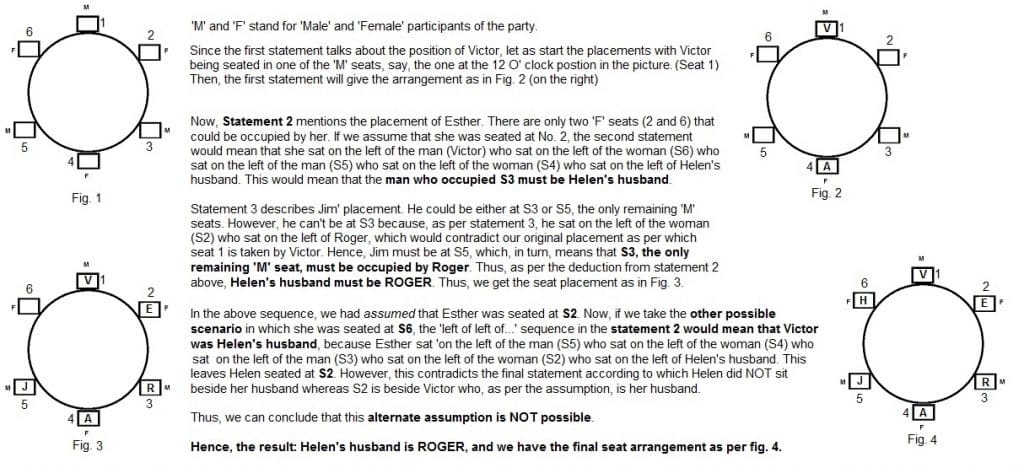
Thus, we have the general arrangement as in Fig. 1. (‘M’ and ‘F’ indicate Male and Female participants of the party. Seats are numbered for ease of reference.)Since the first statement regarding the seating arrangement talks about the position of Victor, let us start by placing him in one of the ‘M’ seats, say, Seat No. 1. (Can be 3 or 5 as well, makes no difference except for corresponding change in the seat taken by Anna) Then we have the seat positions as in Fig. 2.
Statement 2 mentions the placement of Esther. There are only two ‘F’ seats (2 and 6) that could be occupied by her. If we assume that she was seated at No. 2, the second statement would mean that she sat on the left of the man (Victor) who sat on the left of the woman (S6) who sat on the left of the man (S5) who sat on the left of the woman (S4) who sat on the left of Helen’s husband. This would mean that the man who occupied S3 must be Helen’s husband.
Statement 3 describes Jim’ placement. He could be either at S3 or S5, the only remaining ‘M’ seats. However, he can’t be at S3 because, as per statement 3, he sat on the left of the woman (S2) who sat on the left of Roger, which would contradict our original placement as per which seat 1 is taken by Victor. Hence, Jim must be at S5, which, in turn, means that S3, the only remaining ‘M’ seat, must be occupied by Roger. Thus, as per the deduction from statement 2 above, Helen’s husband must be ROGER. Thus, we get the seat placement as in Fig. 3.
Now, the only remaining seat is S6 which must be occupied by Helen. (This also satisfies the last statement that Helen did NOT sit beside her husband. This completes the seating arrangement.
————————————————————————————————————————–In the above sequence, we had assumed that Esther was seated at S2. Now, if we take the other possible scenario in which she was seated at S6, the ‘left of left of…’ sequence in the statement 2 would mean that Victor was Helen’s husband, because Esther sat “on the left of the man (S5) who sat on the left of the woman (S4) who sat on the left of the man (S3) who sat on the left of the woman (S2) who sat on the left of” Helen’s husband. This leaves Helen seated at S2, the only ‘F’ seat remaining. However, this contradicts the final statement according to which Helen did NOT sit beside her husband whereas S2 is beside Victor who, as per the assumption, is her husband.
Thus, we can conclude that this alternate assumption is NOT possible.
Hence, the result: Helen’s husband is ROGER, and we have the final seat arrangement as per fig. 4.
- 7282 views
- 2 answers
- 0 votes
-
Tony is 15, John is 24, Jacob, 12
Explanation:
1. Let Tony’s age be X. Since his father who is 45, is 15 yrs older than twice his age, 2X + 15 = 45 => X = 15.
2. Let Jacob’s age be Y, and John be Z.
Since John is twice as old as Jacob, Z = 2Y.
3 years from now, their ages will be Y + 3 and Z + 3. But since Z = 2Y, this implies that the ages will be Y + 3 and 2Y + 3.
The sum of the ages = Y + 3 + 2Y + 3 = 3Y + 6 = 42. Hence Y = 12; Z = 24.This answer accepted by SherlockHolmes. on 24th January 2018 Earned 20 points.
- 4808 views
- 1 answers
- 0 votes
-
Not just one word…
There are some other words that are WRONGFUL or spelled either WRONGLY or WRONGFULLY etc…. 🙂
- 4413 views
- 1 answers
- 0 votes
-
He’s “Mr. ALARM” (provided you’re the type of person who is reluctant to wake up)…!!
This answer accepted by SherlockHolmes. on 23rd January 2018 Earned 20 points.
- 3157 views
- 1 answers
- 0 votes
-
The team won 10 matches (out of X matches played). Since the win percentage is 40, it means 10 is the 40% of X.
i.e., X * 0.4 = 10 => X = 25.Answer: 25 Matches
- 4346 views
- 1 answers
- 0 votes
-
The puzzle says “I am short“.
You are ‘short’, literally…! Yes, you ARE Short, indeed…! I mean, you are the word “SHORT” which is longer than (the word) “LONG”.
This answer accepted by EagleEyes460. on 3rd January 2018 Earned 20 points.
- 3051 views
- 1 answers
- 0 votes
-
Answer-Letter ‘E‘ (NOT used even once in the entire portion)
Though not literally “unique“, this ‘(partial) paragraph’ is, to be fair, fairly rare. Rare because the entire paragraph does not feature a single instance of the most-used letter in English. Yes, the letter ‘E‘ is NOT used even once in the entire portion quoted. (However, it’s not “unique” because there are even entire books (not just a short paragraph) in which the letter ‘E’ doesn’t appear even once.)
This answer accepted by SherlockHolmes. on 3rd January 2018 Earned 20 points.
- 3791 views
- 1 answers
- 0 votes
-
The “Expected Answer” seems to be a classic case of putting the judge in a paradox – by stating the ‘false’ side of the condition. (i.e., in the present case, tell that he will be hanged (which is equated with a ‘wrong’ answer).)
However, the statement of the puzzle has a flaw: It says “If the thief lies, he will be hanged”. A statement can be classified as a LIE if and only if it can be proven that the person who made the statement was aware of the TRUTH but had deliberately given the wrong statement. e.g. Consider the statement below:
Mr. George W. Bush was the 41st President of the USA.
This statement CAN’T be termed as a ‘LIE‘ (even though it is factually incorrect) unless it can be proven that the person who made the statement was aware that it was wrong and had deliberately made the wrong statement (for whatever reason). Otherwise, it can only be treated as a wrong statement (which might have been made because the person who made the statement was not aware of the fact).
In the current case, the thief doesn’t know whether he will be hanged or beheaded. So, whatever he might say about the manner of his death can’t be treated as a “LIE”. So, the “if he lies” part of the puzzle statement doesn’t fit.
- 5739 views
- 2 answers
- 0 votes
-
TWO Possible answers: (NOT considering ‘fraction ages’ such as X years and Y months and ‘improbable ages’ such as above 120 years)
(1) The man is 40 and his friend is 30
Sum of their ages = 40 + 30 = 70.
When the man’s age was half the sum of their present ages, he was 70 / 2 = 35 (i.e. 5 years ago).
At that time, his friend was 25. When the man is twice this age (the age his friend was when the man was 35), he (the man) would be 25 x 2 = 50 (i.e., 10 years from now.) By that time, his friend (who is 30 now) will have turned 30 + 10 = 40, which is as old as the man is now.(2) The man is 80 and his friend, 60
Sum of ages = 140.
When the man’s age was half the sum of their present ages, he was 140 / 2 = 70 (i.e. 10 years ago).
At that time, his friend was 50. When the man is twice this age (the age his friend was when the man was 70), he (the man) would be 50 x 2 = 100
(i.e., 20 years from now.) By that time, his friend (who is 60 now) will have turned 60 + 20 = 80, which is as old as the man is now.If we consider fraction ages, there can be multiple possible answers (fractions of the above-said figures. e.g. 20 and 15, 60 and 45 etc.)
This answer accepted by SherlockHolmes. on 27th December 2017 Earned 20 points.
- 4503 views
- 1 answers
- 0 votes
-
Considering MY room: I have one cot (on which the bed lies), one table and one chair in my room, each of them having four ‘legs’ each, all on the floor. That makes a total of 12 legs. And, well, I do have two legs as well…! So, assuming that I entered the room on foot (as against on a skateboard or a wheelchair or some other contraption that doesn’t have legs OR have more than two legs), AND NOT considering the legs of other creatures (such as ants. termites etc.) that may be moving around in the room but the exact count is unknown, that would be 12 + 2 = 14 legs on the floor. 🙂
But, if the ‘legs’ of furniture don’t count, it would be just two legs – those of mine. 🙂
- 5201 views
- 1 answers
- 0 votes