




- SherlockHolmes
- Email is hidden.
5849
points
Questions
3400
Answers
237
-
C opens the lock
- 7510 views
- 3 answers
- 0 votes
-
1. Cheese – Above piano playing man on the colorful umbrella.
2. Hungry – On the Menu board just after entering the door.
3. Music – On left table, On boy’s Blue trouser.
4. Red – on the falling drink in the left hand of waitress.
5. Party – On the Piano’s , above man’s hand.
6. Yummy – On left table, on bottom left girl’s orange Hair
This answer accepted by SherlockHolmes. on 13th March 2016 Earned 20 points.
- 5777 views
- 1 answers
- 0 votes
-
Number the bottles 1 to 1000, and write the number in binary format.
bottle 1 = 0000000001
bottle 250 = 0011111010
bottle 1000 = 1111101000
Now take your prisoner’s 1 through 10
and
Let prisoner 1 take a sip from every bottle that has a 1 in its least significant bit.
Let prisoner 10 take a sip from every bottle with a 1 in its most significant bit. etc.Prisoner – 10 9 8 7 6 5 4 3 2 1
Bottle 924 – 1 1 1 0 0 1 1 1 0 0
In this, bottle #924 would be sipped by 10,9,8,5,4 and 3That way if bottle #924 was the poisoned one, only those prisoners would die.
After four weeks,
line the prisoners up in their bit order and read each living prisoner as a 0 bit and each dead prisoner as a 1 bit.The number that you get is the bottle of wine that was poisoned.
This answer accepted by SherlockHolmes. on 5th March 2016 Earned 20 points.
- 14551 views
- 3 answers
- 1 votes
-
Answer- Only 2 Brownies
Explanation-
Each time you pay the toll at the bridge half of your brownies i.e 1 brownie.
They give you 1 brownie back as well.This answer accepted by SherlockHolmes. on 2nd March 2016 Earned 20 points.
- 4868 views
- 3 answers
- 0 votes
-
Answer – 20 Km
Explanation-
Suppose two exchanges be A and B
We have 120 Cables
So,
We start at A ,
Connect wires in group of 1, 2, 3… 15
Now,
walk to the other exchange B(10 Km), and using the battery and bulb, identify the groups 1 to 15.Then number the wires as:
wire 1 in group 1,
wire 2 and 3 in group 2,
wire 4, 5 and 6 in group 3 and so on…Then connect the first wire from each group to wire 1, second wire from each group to wire 2, third wire from each group to wire 3 and so on…
Travel back to the first exchange i.e. A(another 10 Km) and
Number each of the wires as follows:
Number group 1 wire as 1.
Then from each group, identify the wire connected to wire 1 and no. them as the first wire in the groups i.e. 2,4,7…
Similarly, from each group identify the wire connected to wire 2…And Hence we’ll have all the wire correctly numbered, by traveling just 20km.
This answer accepted by SherlockHolmes. on 23rd February 2016 Earned 20 points.
- 10192 views
- 2 answers
- 0 votes
-
The answer is 90 hours.
EXPLANATION-
Surprising as it may seem, the answer follows from the properties of matter and Avogadro’s number.All the answers provided here so far assume that the bucket of water is infinitely divisible. But the fact is there comes a stage where you are left with just one molecule in the bucket. You cannot divide a single molecule any further without losing the property of water. It is a fundamental principle of chemistry. You stop when the bucket has just one molecule or you remove that one molecule also after one hour.
With that background, let us look at the calculations.
One mole of water weighs 18.015 grams.
One mole of water (any substance for that matter) contains 6.022 x 10^23 molecules (Avogadro’s number).
To keep the calculations simple, let us assume the bucket holds 36 litres or 36 kilograms of water (that is a reasonable size also).
36 kgs of water is equal to 2000 moles (approx).
2000 moles of water contain 2000 x 6.022 x 10^23 = 1.2044e+27 molecules.
hours Molecules
0 1.2044e+27
1 6.022E+26
2 3.011E+26
3 1.505E+26
.
.
.
87 7.783E+00
88 3.892E+00
89 1.946E+00
90 9.729E-01 (Note the sign has flipped from + to -)You can also start with one molecule at zero hours, double the quantity every hour and see how long it takes to reach 1.2044e+27 molecules.
If you double the size of the bucket, the time goes up by one more hour.
Here is the python script that did the actual calculation:
molecules = 2000 * 6.022 * 10 ** 23
hours = 0
while molecules > 1:
molecules = molecules / 2
hours = hours + 1
print hours, ‘%.3E’ % moleculesSource – Quora
This answer accepted by SherlockHolmes. on 22nd February 2016 Earned 20 points.
- 10047 views
- 1 answers
- 0 votes
-
5
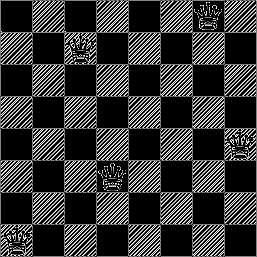
This answer accepted by SherlockHolmes. on 2nd February 2016 Earned 20 points.
- 5868 views
- 2 answers
- 1 votes
-
Answer – Cousins
Explanation-
Christy is Parent of Duke.
|
Sister (Christy is Alex’s sister.)
|
Alex Parent of B.
|
Brother (Enrique is Alex’s brother )
|
Enrique is Parent of Faina.Faina, B and Duke are cousins.
This answer accepted by SherlockHolmes. on 31st January 2016 Earned 20 points.
- 5485 views
- 2 answers
- 1 votes
-
Answer- I suggest Jacob to play second
Explanation-
Let’s suppose that jacob plays first and he picks 9. This means Jack will surely pick 8.
Now, Jacob will have to pick 7 or Karan will pick 7 in his turn. But if Jacob picks up 7, then he will score 16 that is beyond 15 and will lose.
So, It is for sure, NO one will be willing to start with the highest digits.Suppose, Jacob plays first and picks up 1, John will pick 2. Then Jacob will pick 3 and John will pick 4. Now Jacob will be forced to pick 9. The score is 6 to 13 and thus Jacob will have no chance of winning.
If Jacob Picks 9 after John has picked up 2, then John will pick 8 and the score will become 10 to 10. Thus Jacob will pick 3 as picking 7 will send him past 15. Now John will pick 4 and Jacob has nothing to pick for winning. Thus John wins.
Therefore, I suggest Jacob to play second.
- 4690 views
- 3 answers
- 0 votes
-
Answer- House A
Explanation:
In the House A–
As per puzzle, 1 child is Boy
There can be three possibilities.
———————–
Older | Younger
———————–
Boy | Girl
Girl | Boy
Boy | Boy
All these options are equally possible and thus we will take them all into account.
Two of the cases have a girl and thus the probability here will be 2/3.In the House B-
As per puzzle, the elder child is a boy and thus there can be only two possibilities:
————————–
Older | Younger
————————-
Boy | Girl
Boy | BoyHere, the probability of having a girl child will be 1/2.
Thus we must select the house A, as there is better probability of having a girl in that house.
- 5897 views
- 2 answers
- 0 votes